Why AI Models Fail in the Real World
Introduction
Here is a scenario that frustrates almost every data scientist eventually. You train a model. It achieves strong results on the test set. You deploy it. And then, gradually or suddenly, something goes wrong. Predictions that made perfect sense in the notebook seem off in production. Users report problems you cannot reproduce. A metric that looked healthy in validation begins trending in the wrong direction.
This gap between laboratory performance and real-world reliability is not a fringe edge case. It is one of the central challenges in applied machine learning. Models that perform brilliantly in evaluation routinely underperform or fail outright after deployment, and the reasons are specific, recurring, and underestimated during development far more often than they should be.
This article walks through the most important reasons AI models fail after deployment: why they fail, how each failure mode manifests, and what can be done to reduce the risk.
Problem Statement
The difficulty is that development-time evaluation creates an illusion of readiness. When you split data into a training set and a test set, control the experimental conditions, and measure performance against a consistent benchmark, everything is by definition cleaner and more predictable than the messy, evolving environment your model will actually face once deployed.
Real-world data is noisier. Real-world users behave in ways that training data did not capture. The world itself changes over time in ways that invalidate assumptions the model baked in during training. And once a model is embedded in a production system, it becomes part of a dynamic environment with feedback loops, pipeline dependencies, and evolving inputs that offline evaluation simply cannot simulate.
Understanding why models fail is the foundation of building systems you can actually trust.
Core Concepts and Terminology
| Term | Definition |
|---|---|
| Distribution shift | The statistical properties of deployment data differ from those of training data |
| Covariate shift | Input feature distributions change, but the relationship between inputs and outputs stays the same |
| Concept drift | The relationship between inputs and the correct output actually changes over time |
| Data leakage | Information about the target variable inadvertently appears in the training features, making the model appear to generalize when it is actually peeking at the answer |
| Feedback loop | The model's predictions influence the data it is later trained on, creating circular dependencies that distort future performance |
| Calibration | Whether a model's stated confidence matches its actual accuracy, a model stating 80% confidence should be correct roughly 80% of the time |
| Subgroup disparity | The model performs well on average but systematically fails for specific population segments |
Failure Mode 1: Benchmarks Are Cleaner Than Reality
Most ML models are trained and evaluated on curated benchmark datasets. These datasets are cleaned, carefully labeled, and often deliberately balanced in ways that real-world data is almost never is. They are designed to serve as fair, reproducible comparison environments, which is valuable for research but creates a persistent false impression of how a model will perform outside the lab.
In deployment, models encounter things that benchmarks exclude or underrepresent. Forms arrive with missing fields. Images come in with poor lighting or unusual angles. Text contains typos, slang, abbreviations, and domain-specific usage that didn't appear in training. Audio carries background noise. Edge cases arise that technically fall within the model's domain but represent input combinations the training set never included.
High benchmark performance is a necessary but not sufficient condition for real-world reliability. Think of a benchmark score as evidence that the model can work under controlled conditions. It tells you nothing about whether it will work under your specific, uncontrolled, evolving conditions.
Failure Mode 2: Distribution Shift
Most machine learning relies on a foundational assumption: the data the model trains on and the data it later makes predictions on come from the same statistical distribution. In other words, the model assumes the world it learned from is the same world it will encounter in production.
This assumption is almost never fully true. The gap between training data and deployment data is called distribution shift, and it is one of the most common causes of real-world model failure.
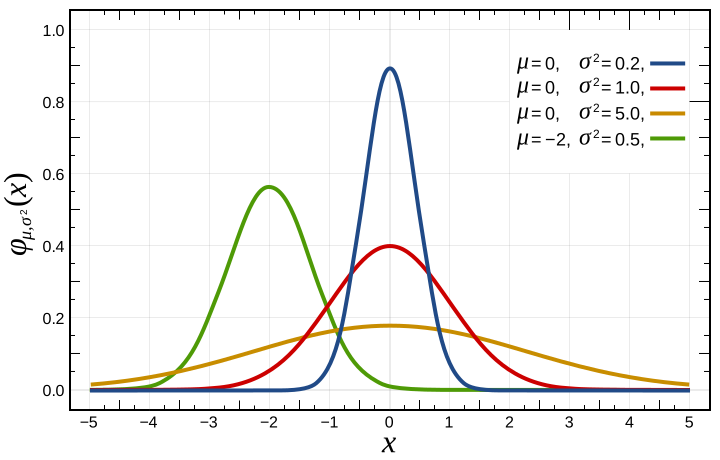
Distribution shift takes several distinct forms, each with different implications:
- Covariate shift: The distribution of input features changes, but the relationship between inputs and outputs stays the same. A fraud detection model trained on transactions from one country faces a different distribution of transaction types when deployed globally, even though fraud is still fraud.
- Label shift: The frequency of different outcomes changes. A medical diagnostic model trained during a disease outbreak, when prevalence is high, deployed after the outbreak ends will encounter far fewer positive cases. The same input features now correspond to a different baseline probability of the outcome.
- Concept drift: The relationship between inputs and the correct output actually changes over time. A sentiment classifier trained before a major cultural event may find that words it associated with positive sentiment are now used sarcastically. The inputs look the same; the correct labels have changed.
- Temporal shift: Data collected years apart looks different in ways that are hard to fully characterize. Customer behavior, language patterns, economic conditions, and social norms evolve. A model trained on 2018 data may fail to capture patterns characteristic of 2025 users.
Even small shifts can produce large performance drops, especially for complex models that have learned very specific training-data patterns. Simpler models with stronger inductive biases, built-in assumptions about how the world works, are often more robust to distribution shift precisely because they have less capacity to memorize training-specific details.
Failure Mode 3: Metrics Hide Important Failures
Metrics like accuracy, RMSE, and AUC are summary statistics. They compress model behavior across thousands or millions of examples into a single number. That compression is useful for comparing models or tracking overall trends, but it hides exactly what matters most: where the model fails and what kind of failures it makes.
- Class imbalance: A model predicting loan default can achieve 97% accuracy if only 3% of loans actually default, simply by predicting "no default" for every application without exception. The metric looks excellent. The model is completely useless for its intended purpose.
- Subgroup disparities: A facial recognition model might achieve 95% overall accuracy but only 72% accuracy for women with dark skin tones, because that group was underrepresented in training data. The aggregate metric hides systematic bias against a specific population, often the population with the most at stake in the model's decisions.
- Performance at decision boundaries: Many ML systems make binary decisions at a threshold. Aggregate metrics don't reveal how stable predictions are near that threshold, where small score changes flip the decision and where individual errors have the highest consequences.
- Error asymmetry: Many error metrics treat overestimates and underestimates as equally costly. In most real applications they are not. Under-predicting inventory has very different consequences from over-predicting it. A metric that treats these errors symmetrically obscures which type of failure is actually happening.
The practical response: never rely on a single aggregate metric. Disaggregate performance by subgroup, input type, and output region. Confusion matrices, calibration plots, and performance-by-feature-slice analysis reveal what aggregate metrics conceal.
Failure Mode 4: Subtle Overfitting
The dramatic version of overfitting, 99% training accuracy, 60% test accuracy, is visible and easy to catch. The dangerous version is subtle. A model can perform consistently on validation data, pass cross-validation checks, and look stable across multiple runs while still being overfit to training-specific patterns that happen to also appear in the validation set.
Subtle overfitting often traces to a few specific causes:
- Validation set contamination: When hyperparameters are tuned by repeatedly checking validation performance, the model's configuration gradually adapts to validation-specific patterns. The validation set ceases to be an independent estimate of generalization. This is sometimes called overfitting to the validation set, and it is widespread in competitive machine learning.
- Spurious correlations: Training data contains correlations that predict the target within the training distribution but have no causal relationship to it. A well-documented example: some medical AI models trained on X-ray data learned to associate scanner artifacts and equipment identifiers with diagnoses, because certain hospitals used older equipment for specific patient populations. The equipment, not the pathology, was driving predictions.
- Data leakage: Information from the future or from the target variable accidentally contaminates the training features. A churn prediction model that includes the date of the customer's account cancellation as a feature will appear to predict churn with near-perfect accuracy, because it has access to the answer hidden inside a feature.
Failure Mode 5: Models Are Embedded in Systems
A deployed ML model is never just a model. It receives inputs from upstream data pipelines, makes predictions that feed into downstream decisions, and operates in an environment where users, other systems, and data evolve continuously. This creates failure modes that are invisible in offline evaluation.
- Self-fulfilling predictions: A model predicting which customers are likely to churn is used to target them with retention offers. Those customers, having been retained, are later labeled "did not churn" in the next training cycle. The model never sees what would have happened without intervention, and future predictions are biased by this invisible counterfactual.
- Adversarial adaptation: When a spam filter is deployed, spammers study which messages get through and adapt accordingly. The model was trained on one generation of spam. Production spam evolves in direct response to the model's behavior.
- Error propagation: In pipelines where one model's output becomes another model's input, errors accumulate. A small error in an entity extraction step leads to a larger error in the downstream reasoning step that relies on those entities.
- Training data poisoning: In systems that automatically incorporate user feedback into retraining, malicious users can deliberately produce feedback that shifts the model's behavior in unintended directions.
The term hidden technical debt, from a widely cited 2015 Google paper on ML systems, describes precisely this phenomenon: the invisible complexity that accumulates when ML models become embedded in production systems. This complexity rarely appears in offline evaluation. It surfaces in production, often after something has already gone wrong.
Failure Mode 6: Overconfidence Without Uncertainty
Most neural networks produce a prediction and a confidence score. What they do not reliably produce is an accurate estimate of how uncertain that confidence should be. A model encountering an input type it has never seen may still return a 91% confidence score, because it has no mechanism for recognizing that it is operating outside its training distribution.
This is miscalibration: the model's stated confidence does not match its actual accuracy. A well-calibrated model stating 80% confidence should be correct roughly 80% of the time. Many models are systematically overconfident, they state 90% confidence on cases where their true accuracy is closer to 70%.
In high-stakes domains like medicine, finance, or legal decisions, knowing when the model is uncertain is often more important than raw accuracy. A model that correctly handles 95% of cases and clearly flags the uncertain 5% for human review may be far more valuable than one that confidently handles 97% while hiding the cases it is most likely to get wrong. Uncertainty quantification is an active area of research, and a genuinely underinvested part of most production ML systems.
Failure Mode 7: No Monitoring After Deployment
Deployment is not the finish line. It is the beginning of a new phase. A model that performs well at launch will degrade over time as the world it was trained on changes around it. Without active monitoring, that degradation often goes undetected until it causes visible, serious problems.
Effective production monitoring tracks several distinct layers:
- Input data monitoring: Track the statistical properties of features the model receives. When distributions shift significantly from training baselines, predictions are likely becoming unreliable, often before any ground-truth degradation is visible.
- Prediction monitoring: Track the distribution of model outputs. A model suddenly predicting fraud far more or less frequently than baseline may be responding to a real change in the world, or to a data pipeline problem.
- Ground truth monitoring: Where delayed feedback is available, track actual accuracy over time. This is the most direct signal of model degradation, but it requires waiting for outcomes to materialize.
- Business metric monitoring: Track the downstream consequences of model-driven decisions on the metrics that actually matter, revenue, user satisfaction, safety outcomes. If model predictions are leading to worse real-world outcomes, that signal takes priority over all others.
Practical Example: A Silent Failure
Consider a model built to flag fraudulent financial transactions. It is trained on two years of transaction data, achieves high precision and recall in validation, and is deployed to review incoming transactions in real time.
For the first three months, performance is strong. In month four, a new category of mobile payment transaction type becomes prevalent across the platform. The training data contained very few examples of this transaction type. The model, encountering these transactions at volume, does not recognize them as unfamiliar, it confidently classifies them using whatever features are most correlated with its training-time patterns. Because the new transaction type has superficial similarities to a low-fraud category in the training data, the model begins systematically missing fraud within this category.
The new category represents only a fraction of total transaction volume, so overall fraud detection metrics remain broadly healthy. As a result, the failure goes undetected for weeks. It is eventually identified through a disaggregated analysis of fraud miss rates by transaction type. The fix requires not just retraining but a deliberate data collection effort to obtain representative examples of the new transaction category, followed by evaluation specifically on that slice.
This scenario is not unusual. It illustrates how distribution shift, metric blindspots, and absence of disaggregated monitoring combine to produce failures that look invisible at the aggregate level until the damage is already done.
Advantages of Understanding These Failure Modes
- Earlier detection: Teams that understand these patterns look for them proactively during development, catching problems before deployment rather than after.
- Better evaluation design: Understanding what benchmarks miss leads to more realistic evaluation setups, disaggregated metrics, held-out temporal splits, deliberate adversarial testing.
- More honest communication: Knowing the real limitations of a model allows for honest communication with stakeholders about where the model should and should not be trusted.
- Prioritized monitoring investment: Understanding which failure modes are most likely for a specific system guides where to invest in monitoring rather than treating all risks as equally likely.
Common Mistakes
- Treating benchmark performance as a deployment guarantee. Benchmark scores establish a floor, not a ceiling. They tell you the model can work under controlled conditions. They tell you nothing about whether it will work in your specific production environment.
- Relying on a single aggregate metric. Aggregate accuracy, AUC, or RMSE will hide systematic failures in subgroups, at decision boundaries, and across different error types. Always disaggregate.
- Skipping monitoring after deployment. Models degrade. The question is not whether degradation will happen but whether you will detect it early enough to respond before it causes harm.
- Assuming the pipeline is neutral. Every step in the data pipeline between the real world and the model introduces potential for shift, leakage, or error propagation. Pipeline health is part of model health.
- Confusing confidence with correctness. A model's stated confidence is not a reliable indicator of its actual accuracy, especially on inputs outside its training distribution. High confidence on unfamiliar inputs is the norm for overconfident models, not a reassuring signal.
Best Practices
- Evaluate on realistic, heterogeneous data that reflects the diversity of inputs the model will actually encounter, not just the clean version that survived data preprocessing.
- Always disaggregate performance metrics by population subgroup, input type, and temporal slice. Look for systematic failures that aggregate metrics average away.
- Design evaluation setups that mimic the temporal structure of real deployment. Where possible, evaluate on future data rather than a random sample of all available data.
- Build monitoring into the deployment plan from the start. Define what drift detection and ground truth tracking will look like before the model goes live, not after.
- Think about your model as a component of a larger system. Understand the feedback loops it participates in and how the system's behavior might change as users and other components respond to its predictions.
- Treat suspiciously good results with skepticism. Investigate potential leakage before celebrating exceptional performance.
Comparison: Evaluation Settings
| Setting | What It Tests | What It Misses |
|---|---|---|
| Random train/test split | Generalization within the same distribution | Temporal shift; population subgroup failures; real-world noise |
| Temporal split (train on past, test on future) | Robustness to time-based distribution shift | Geographic or demographic shift; adversarial inputs |
| Disaggregated evaluation by subgroup | Differential performance across populations | Interactions between subgroups; rare edge cases |
| Adversarial / stress testing | Robustness to unusual, extreme, or malicious inputs | Typical performance; common failure modes |
| A/B test in production | Real user behavior in real conditions | Can only test changes, not absolute quality; requires deployment |
FAQ
Why do models that perform well in testing fail in production?
Because production data is different from training and test data in ways that evaluation cannot fully anticipate. The real world is messier, changes over time, and presents inputs and contexts that the training distribution did not represent. Additionally, test sets are typically constructed from the same data source as training sets, which means they share the same biases and gaps.
What is the most important thing to monitor after a model is deployed?
The most informative signals, in rough order, are: input data distribution (catches distribution shift early), model prediction distribution (catches systematic behavioral changes), and ground truth accuracy (the most direct signal, but requires waiting for outcomes). Business metric impact is the ultimate ground truth but is often delayed and harder to attribute cleanly to the model.
How can I detect data leakage before deploying a model?
Look for suspiciously good performance, significantly better than the best published benchmarks or reasonable priors. Inspect feature importances carefully: if a feature with no plausible causal relationship to the target is the most predictive, investigate why. Simulate the production setting by ensuring that features used in training would actually be available at prediction time in real deployment. Reconstruct the timeline: does the model have access to any information that came after the event it is supposed to predict?
How often should a model be retrained?
It depends on how quickly the deployment distribution drifts from the training distribution. Some models are stable for years; others become unreliable within weeks. The right answer comes from monitoring: when input distributions drift beyond defined thresholds, or when ground truth accuracy begins declining, retraining is warranted. Scheduled periodic retraining without monitoring is a poor substitute for drift-triggered retraining based on actual evidence.
Is it possible to build a model that is truly robust to distribution shift?
Fully robust models do not exist, but models can be made more robust through choices like simpler architectures with stronger inductive biases, training on diverse and representative data, deliberate domain randomization, and causal modeling approaches that try to learn underlying mechanisms rather than statistical correlations. These strategies reduce vulnerability without eliminating it.
References
- Sculley, D., et al. (2015). Hidden Technical Debt in Machine Learning Systems. NeurIPS 2015.
- Moreno-Torres, J. G., et al. (2012). A unifying view on dataset shift in classification. Pattern Recognition, 45(1), 521–530.
- Wagstaff, K. (2012). Machine Learning That Matters. ICML 2012.
- Guo, C., et al. (2017). On Calibration of Modern Neural Networks. ICML 2017.
- MLOps Community. Monitoring in Production
Key Takeaways
- Benchmark performance measures best-case behavior under controlled conditions, not real-world reliability. Use it as a floor, not a guarantee.
- Distribution shift is the norm in production ML, not an edge case. Every model should be designed and monitored with the assumption that deployment data will differ from training data.
- Aggregate metrics hide critical failures. Disaggregated evaluation across subgroups, temporal slices, and error types is necessary to build genuine confidence in a model.
- Deployed models are embedded in systems with feedback loops, pipeline dependencies, and evolving users. Offline evaluation cannot capture these dynamics, only production monitoring can.
- Overconfident models are dangerous in high-stakes settings. Knowing when a model is uncertain is often as important as knowing its average accuracy.
- Monitoring is part of the product, not an afterthought. Models degrade, and detecting that degradation early requires active, systematic observation from day one of deployment.