Agentic AI: How Autonomous Systems Perceive, Plan, and Act
Introduction
When most people think of AI, they picture a system you talk to: you ask a question, it answers. You upload a photo, it describes it. Every interaction is a single exchange, input in, output out, done. This model of AI has dominated the past decade of consumer applications, from search engines to voice assistants to image generators.
A new class of AI systems works fundamentally differently. Instead of waiting for you to ask the next question, these systems can set their own sub-goals, take sequences of actions, check whether their actions worked, and adjust their plan, all without you guiding each step. This is called agentic AI, and it represents a meaningful shift in what AI can actually accomplish in the world.
This guide is written for beginners and curious non-specialists. We will start with a concrete analogy, build up the core concepts one at a time, and connect everything to examples you can picture and reason about.
The Problem with Reactive AI
Most AI applications today are reactive by design. You provide an input, the system produces an output, and the interaction ends. This works well for well-defined, single-step tasks: classify this image, translate this sentence, summarize this document.
But many of the tasks that are genuinely valuable to people and organizations are not single-step. Planning a project, debugging a system, conducting research, managing a workflow, all of these involve dozens of decisions, information-gathering steps, and adjustments based on what you discover along the way. A reactive AI handles one step at a time, placing the burden of sequencing, planning, and error-recovery entirely on the human user.
Agentic AI is the response to this limitation. It shifts that coordination burden onto the system itself, allowing humans to specify goals rather than micromanage every step toward them.
What Is Agentic AI? Starting with an Analogy
Think about the difference between a vending machine and a personal assistant.
A vending machine responds to a single input, you press B4, it drops a snack. It cannot adapt if the snack is stuck. It cannot remember what you ordered last time. It cannot plan a healthy diet for the week. It reacts to one request at a time and nothing more.
A personal assistant works differently. You say "help me plan a trip to Tokyo for next month." The assistant does not give you one answer and stop. They look up flights, compare prices, check your calendar, identify clashes, suggest hotels near your conference venue, book a restaurant, send you a summary, and follow up if a flight gets cancelled. They break down the goal, take many steps, observe what works, and adjust when something does not.
Traditional AI chatbots are closer to the vending machine. Agentic AI is closer to the assistant.
Traditional AI answers questions. Agentic AI takes actions.
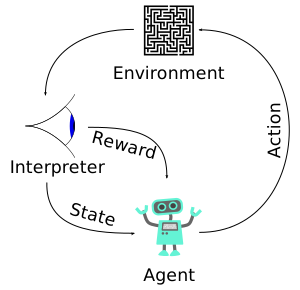
More precisely, an agentic AI system is an AI designed to operate as an agent, an entity that formulates goals and breaks them into sub-tasks, plans sequences of actions to achieve those goals, interacts with external tools and environments, observes the results of its actions, and updates its plan based on what it learned.
Agentic AI vs. Traditional AI: A Direct Comparison
The differences become clearer when you put them side by side. Imagine asking both systems to "write a report on the latest renewable energy trends." A traditional chatbot produces an answer based on its training data, which may be months or years out of date. It gives you one response and waits. An agentic AI might search the web for recent reports, read several articles, extract key statistics, verify their sources, synthesize the findings, check for contradictions, and then deliver a structured report, all in sequence, with minimal intervention from you.
| Aspect | Traditional AI | Agentic AI |
|---|---|---|
| Interaction style | One input, one output | Goal leads to a plan, which leads to many actions, which produce a result |
| Memory | Short-term only, within a single conversation | Can store and retrieve information across sessions and tasks |
| Autonomy | Low, waits for every instruction | Moderate to high, makes decisions and takes steps independently |
| Tool usage | Usually none; generates text from training data | Core capability, can call APIs, run code, browse the web, write to files |
| Error recovery | None, fails silently or gives a wrong answer | Can detect failures and try alternative approaches |
Core Components of an Agentic AI System
Understanding agentic AI means understanding its parts. Most agentic systems share five key components, regardless of the specific technology used.
The Goal
Every agent operates toward a goal. This might be something explicit you have stated ("book me a flight to Paris next Tuesday under $600") or something more abstract the system is trying to optimize over time. The goal is the compass that determines which actions are worth taking.
In technical machine learning terms, the goal is often formalized as a reward function or objective function, a way of measuring how well the agent is doing. Designing this correctly is harder than it sounds. A poorly designed objective is one of the main ways agentic systems go wrong, producing behavior that technically satisfies the specification while violating the intent behind it.
The Planner
The planner decides what to do next, given the current situation and the goal. It involves decomposing a large goal ("plan a trip") into sub-goals ("find flights," "find hotels," "check visa requirements") and then into specific actions. In reinforcement learning, the planner is called a policy, a mapping from situations to actions.
Modern agentic AI systems often use large language models as the planner. The language model reasons about what step to take next given the current context, producing a flexible and generalizable planner that can handle open-ended goals.
Memory
Without memory, an agent cannot learn from what it has already done. Memory allows the agent to track what actions it has taken, what information it has gathered, and what has worked or failed. This is what enables planning across many steps, you cannot build on step 3 if you have forgotten step 1.
Memory in agentic systems can take several forms: simple context windows containing everything in the current session, external databases the agent can read and write, or structured logs of past actions and results that persist across separate sessions.
The Tool Interface
Agentic AI becomes genuinely powerful when it can interact with the world, not just generate text. The tool interface is what allows an agent to search the web for current information, run code and observe the output, read and write files, call APIs to interact with external services like calendars or databases, and control software applications. Each tool is essentially a way for the agent to take an action in the world and get a result back. Without tools, an agentic AI is just a sophisticated chatbot, capable of producing detailed plans but unable to execute a single step of them.
The Feedback Loop
The feedback loop is what ties everything together. After the agent takes an action, it observes the result: did the code run without errors? Did the API return the expected data? Did the user indicate the output was wrong? This feedback updates the agent's understanding of the situation and informs the next step.
The feedback loop is what separates agents from simple automation scripts. A script follows fixed steps regardless of what happens. An agent observes outcomes and adapts, which is the difference between a checklist and a thinking assistant.
How It Works: The Agent Loop Step by Step
Most agentic systems follow a recurring cycle. Here is what it looks like in plain language, using the example of an agent tasked with "research the three best open-source libraries for time-series forecasting and summarize their trade-offs."
Step 1, Observe: The agent gathers information about the current situation. What has already been done? What tools are available? What does the goal require? In this case, the agent starts with no prior context and knows it has access to a web search tool and a text-writing tool.
Step 2, Plan: The agent decides what action to take next. It might reason: "I should start by searching for 'best open-source time-series forecasting libraries' to get an initial list." Planning may involve breaking the goal into sub-tasks and deciding on the sequence.
Step 3, Act: The agent executes the chosen action. It calls the web search tool and retrieves a list of results. The action has been taken; now the world has changed slightly.
Step 4, Observe the result: The agent reads the search results. It identifies five candidate libraries. It notices that two are frequently mentioned as industry standards and decides these are good candidates for deeper investigation.
Step 5, Update: Based on what it learned, the agent revises its plan. It will now search for specific benchmarks and documentation for the top three libraries before attempting to write the summary.
Step 6, Repeat: The agent loops back to step 1 with a refined understanding of the situation, continuing until the goal is achieved or it determines it cannot proceed.
This structure closely mirrors classical reinforcement learning, the agent-environment interaction loop that has been studied in AI research for decades. What is new is that modern language models make the planning step far more capable, allowing agents to handle complex, open-ended goals that older RL systems could not approach.
Practical Example: An Agentic Research Assistant
Imagine a data science team that needs to stay current with new research papers in their field. Previously, a team member spent several hours each week searching databases, skimming abstracts, and writing brief summaries for colleagues. Now they deploy an agentic AI to handle this task.
Each Monday morning, the agent receives the goal: "Find all papers published this week on large language model evaluation, summarize the five most relevant ones, and send a digest to the team Slack channel." The agent searches two academic databases, retrieves abstracts, reads full papers for the top candidates, extracts key findings and methodologies, compares them against the team's research focus, writes structured summaries in plain language, and posts the digest, all without human intervention during the process.
When a paper link is broken, the agent tries an alternative source. When the search returns too many results, it applies additional filters based on citation counts and recency. It observes obstacles and adapts rather than stopping and waiting for a human to fix the problem.
The team now receives a consistent, high-quality weekly digest. The team member who previously spent hours on this task now spends fifteen minutes reviewing and commenting on the agent's output. This is the practical value of agentic AI: it handles the coordination and execution of multi-step workflows, freeing humans for judgment and oversight.
Advantages of Agentic AI
- Handles multi-step tasks autonomously: The most important advantage is the ability to complete complex workflows without requiring a human to direct each individual step. This is qualitatively different from any prior generation of AI tools.
- Adapts to unexpected situations: Because agents observe results and update plans, they can recover from errors and handle situations their designers did not anticipate, something static automation cannot do.
- Integrates with existing systems: Through tool use, agents can interact with databases, APIs, calendars, and software applications, embedding intelligence into workflows that already exist rather than requiring everything to be rebuilt.
- Scales human expertise: A single domain expert can configure an agent with their knowledge and processes, and that expertise is then available continuously at scale, handling tasks that would otherwise require multiple people.
- Reduces cognitive load: By managing sequencing, error recovery, and information gathering, agents free human attention for the high-judgment decisions that actually require it.
Limitations and Trade-offs
- Error amplification: In a traditional model, a single wrong answer ends there. In an agentic system, a wrong decision at step 2 leads to a wrong action at step 3, which changes the environment in step 4, which leads to a wrong decision at step 5. Small mistakes compound into large failures. This makes debugging significantly harder than debugging a classifier.
- Safety and unintended consequences: An agent that can take actions in the world, send emails, modify files, call APIs, can cause real harm if those actions are wrong. A coding agent that deletes the wrong files, or a scheduling agent that cancels the wrong meetings, creates problems that may be difficult or impossible to reverse.
- Alignment with human intent: Specifying exactly what you want in a goal is harder than it seems. An agent optimizing for "maximize engagement" might recommend increasingly extreme content. An agent told to "clean up the codebase" might delete code it does not understand. The gap between what you specify and what you actually want is called the alignment problem, and it is one of the central research challenges in AI safety.
- Evaluation difficulty: For a classifier, you can measure accuracy on a test set. For an agent, success depends on whether it achieved a complex goal across a multi-step process, and there may be many valid paths to success and many subtle ways to fail. Designing good evaluations for agents is an open and largely unsolved problem.
- Unpredictable failure modes: Agents interacting with real-world environments encounter situations their designers never anticipated. Unlike static models, agents can actively create novel situations through their actions, and fail in ways that are fundamentally hard to predict in advance.
Common Mistakes When Working with Agentic Systems
- Giving the agent too much autonomy too soon: Starting with high-stakes tasks that are difficult to reverse is a common and costly mistake. Build trust gradually by deploying agents on low-risk workflows first, validating their behavior, and expanding scope incrementally.
- Underspecifying the goal: Vague goals like "make the customers happy" or "improve the system" give agents enormous latitude to do the wrong thing. Goals should be specific, measurable, and include explicit constraints on what the agent should not do.
- Neglecting the feedback mechanism: An agent without a well-designed feedback loop is just an automation script. Ensure the system has clear signals about whether its actions are working, not just whether they completed without errors.
- Treating agent output as ground truth: Agentic systems can be confidently wrong. Maintaining human review for consequential outputs, especially early in deployment, is not a sign of distrust in the technology; it is responsible system design.
- Ignoring tool security: Every tool the agent can call is a potential attack surface. An agent given email access, for instance, could be manipulated into sending messages on behalf of the organization. Tool permissions should follow the principle of least privilege.
Best Practices for Agentic AI Deployment
- Start with sandboxed environments: Test agents in isolated systems where their actions cannot affect production until you have validated their behavior thoroughly.
- Implement human-in-the-loop checkpoints: Require human approval before the agent takes high-stakes or irreversible actions. This is a design choice, not a workaround, it should be built into the architecture from the start.
- Log everything: Every action the agent takes, every tool it calls, every decision it makes should be logged with enough context to reconstruct why it happened. This is essential for debugging, auditing, and improving the system.
- Design explicit failure modes: Decide in advance what the agent should do when it is uncertain, when a tool fails, or when a goal cannot be achieved. Agents that have no defined failure mode will invent their own, often in ways you do not want.
- Evaluate on real tasks, not benchmarks alone: Standard ML benchmarks often do not capture the complexity and variability of real-world agentic tasks. Complement benchmark evaluation with real-task testing in representative environments.
Connections to Classical Machine Learning
If you are learning machine learning, you might wonder how agentic AI relates to the fundamentals you are studying. The connection is direct and worth understanding.
| Classical ML Concept | Agentic AI Analogue |
|---|---|
| Loss function minimization | Reward function maximization, the agent's policy is optimized based on reward signals, not labeled examples |
| Metric selection (accuracy vs. F1) | Reward design, the same pitfalls apply; reward functions can be "gamed" just as metrics can be overfitted |
| Overfitting to training data | Agents that work perfectly in test environments but fail in deployment because the real world is more varied |
| Regularization | Action constraints, limiting which actions an agent can take prevents extreme or unintended behavior, analogous to regularizing a model |
Frequently Asked Questions
Is an agentic AI system the same as a chatbot?
No. A chatbot responds to individual messages. An agentic AI pursues goals over multiple steps, takes actions in the world through tools, and adapts based on the results of those actions. A chatbot is a single-turn system; an agentic AI is a multi-step, goal-directed one.
Does agentic AI require reinforcement learning?
Not necessarily. While reinforcement learning is the classical framework for training agents, many modern agentic AI systems are built on top of large language models that were trained primarily with supervised learning and RLHF. The agent architecture, perceive, plan, act, observe, update, does not require the underlying model to have been trained using RL.
How do you know when an agentic AI is doing the right thing?
This is genuinely hard, and it is one of the defining challenges of the field. In the near term, it requires detailed logging, human review of consequential decisions, and systematic evaluation on representative tasks. Research into automated oversight and interpretability tools is ongoing.
What is the difference between an agent and an automation script?
An automation script follows fixed steps regardless of what happens. An agent observes the results of its actions and adapts. If a tool fails, a script stops or errors out; an agent tries an alternative approach. If the environment changes unexpectedly, a script ignores it; an agent updates its plan. Adaptation based on feedback is the defining difference.
Is agentic AI ready for production use?
For carefully scoped, lower-stakes, well-monitored tasks, yes. For open-ended, high-stakes, or safety-critical tasks, not without significant human oversight and robust safety measures. The technology is advancing rapidly, but the engineering discipline around deploying it responsibly is still developing.
References
- Russell, S., & Norvig, P. (2020). Artificial Intelligence: A Modern Approach (4th ed.). Pearson.
- Sutton, R. S., & Barto, A. G. (2018). Reinforcement Learning: An Introduction (2nd ed.). MIT Press.
- Wang, L., et al. (2023). A Survey on Large Language Model-Based Autonomous Agents. arXiv:2308.11432.
- Yao, S., et al. (2022). ReAct: Synergizing Reasoning and Acting in Language Models. arXiv:2210.03629.
- OpenAI. GPT-4 Technical Report
Key Takeaways
- Agentic AI is defined by goal-directedness, multi-step action, and feedback-driven adaptation, not just by being "smarter" than a chatbot.
- The five core components are the goal, the planner, memory, the tool interface, and the feedback loop, every agentic system implements some version of all five.
- The agent loop, observe, plan, act, observe results, update, is simple in principle but powerful in practice, especially when backed by a capable language model as the planner.
- Agentic AI introduces new failure modes: error amplification, alignment gaps, and unpredictable behavior in real environments, all of which require deliberate engineering to manage.
- Safe deployment requires sandboxing, logging, and human oversight checkpoints, especially early in deployment and for consequential tasks.
- The most valuable thing agentic AI offers is not raw intelligence but the ability to coordinate multi-step workflows autonomously, freeing human attention for the judgment that actually requires it.